
A Practical Guide for Australian Small Business Owners
Artificial intelligence is no longer something reserved for tech giants or Silicon Valley startups. It is now firmly in the hands of Australian small business owners who want to save time, reduce admin, and get more value from their websites and marketing.
From answering customer enquiries to drafting website content and improving SEO, AI tools are becoming part of everyday business operations. Used well, they can free you up to focus on the work that actually makes money. Used poorly, they can create generic content, misinformation, or compliance headaches.
At Sites By Design, we have been helping Australian businesses build their online presence for over 15 years. We have seen firsthand how using AI in small business can save time, reduce costs, and help business owners focus on what they do best. This guide will show you practical ways to use AI in your business, with specific examples relevant to your website, marketing, and daily operations.
Understanding AI: What It Actually Is
AI stands for Artificial Intelligence, which refers to computer systems that can perform tasks requiring human-like thinking. You have probably used AI without realising it: voice assistants like Siri, Netflix recommendations, spam filters in your email, and fraud detection on your bank account are all powered by AI.
ChatGPT and similar tools use a technique called deep learning. They have been trained on massive amounts of text from the internet, learning patterns in language that allow them to generate human-like responses. When you ask a question, the AI predicts the most likely helpful response based on everything it has learned.
Important to understand: AI tools can be incredibly helpful, but they are not perfect. They may occasionally provide incorrect information or miss important context. They learn language patterns and generate responses based on probability rather than true understanding.
That distinction matters. AI does not know your business, your customers, or Australian regulations unless you guide it carefully and review its output.
Is AI Safe for Small Businesses to Use?
AI can be safe and effective when used with the right boundaries. The biggest risks come from over-trusting outputs or feeding sensitive information into public tools.
AI tools can occasionally:
- Produce confident but incorrect information
- Miss local context or Australian legal requirements
- Generate content that sounds polished but lacks real expertise
For Australian businesses, this means AI-generated content should always be reviewed before being published, especially when it relates to pricing, legal obligations, health claims, or compliance with laws such as the Privacy Act 1988 or Australian Consumer Law.
Think of AI as a capable assistant, not a decision-maker.
How AI Can Help Your Small Business
Here are practical ways Australian small businesses can use AI tools right now:
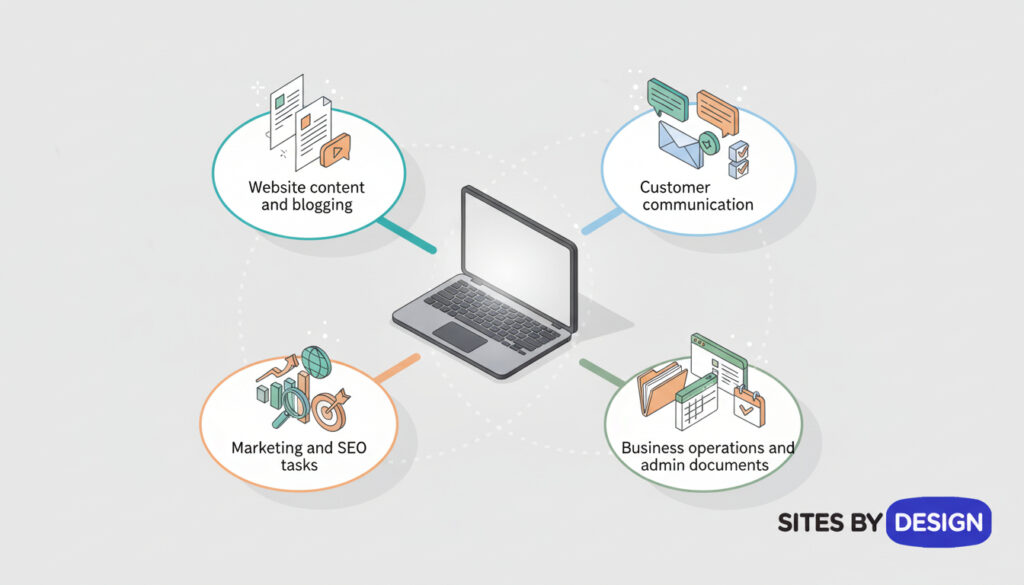
Website Content Creation
- Blog Posts: Generate first drafts for your blog. Tell the AI your topic and target audience, then edit the output to match your voice and add your expertise. Here are more tips on how to do quality blogging on your site.
- Service Descriptions: Create compelling descriptions for your products or services that highlight benefits for Australian customers.
- Meta Descriptions: Write SEO-friendly meta descriptions that encourage clicks in Google search results.
- FAQs: Generate comprehensive FAQ sections based on common questions in your industry.
The key is to treat these drafts as a foundation. Your experience, local knowledge, and customer language should always shape the final version.
Customer Communication
- Email Templates: Create professional email templates for enquiries, quotes, follow-ups, and thank you messages.
- Response Drafts: Draft responses to customer questions or complaints, which you can then personalise.
- Social Media Replies: Generate quick, professional responses to comments and messages on your business pages.
This is especially valuable for tradies and service businesses juggling admin after hours.
Marketing and SEO
- Keyword Research: Ask AI to suggest relevant keywords for your industry and location, such as “best plumber Sydney” or “organic cafe Melbourne”.
- Social Media Posts: Generate a month’s worth of social media content ideas and draft posts.
- Google Business Profile: Write compelling business descriptions and responses to reviews.
- Ad Copy: Create variations of Google Ads or Facebook Ad copy to test different approaches.
AI does not replace an SEO strategy, but it can speed up execution when paired with proper planning.
Business Operations
- Meeting Summaries: Paste your meeting notes and ask AI to create a clear summary with action items.
- Document Drafting: Create first drafts of policies, procedures, or standard operating documents.
- Spreadsheet Formulas: Describe what calculation you need and let AI write the Excel or Google Sheets formula.
- Research and Learning: Quickly understand new topics, regulations, or industry trends relevant to your business.
These small efficiencies add up quickly for time-poor business owners.
Getting Started: A Step-by-Step Guide
Step 1: Choose Your AI Tool
Several AI tools and assistants are available, each with their own strengths:
- ChatGPT (OpenAI): The most widely used option. Free tier available, with a more powerful paid version. Good for general business tasks.
- Claude (Anthropic): Excellent for longer documents and detailed analysis. Known for being helpful and following instructions carefully.
- Google Gemini: Integrates well with Google Workspace. Good option if you already use Gmail, Google Docs, and Google Drive.
- Microsoft Copilot: Built into Microsoft 365. Ideal if your business runs on Word, Excel, and Outlook.
Step 2: Create an Account
Visit the website of your chosen tool and sign up. Most offer free tiers that are perfectly adequate for getting started. You can always upgrade later if you find yourself hitting limits.
Step 3: Write Effective Prompts
The key to getting useful results from AI is writing clear, specific prompts. Here is the formula:
- Context: Tell the AI who you are and what your business does
- Task: Clearly state what you want it to do
- Details: Include specific requirements like tone, length, or format
- Audience: Specify who will read or use the output
Example Prompts for Small Business:
| Bad prompt: “Write about plumbing.” Good prompt: “I run a plumbing business in Brisbane. Write a 300-word blog post about preventing blocked drains in summer, targeted at homeowners. Use a friendly, helpful tone and include 3 practical tips.” Bad prompt: “Help with email.” Good prompt: “Write a professional follow-up email to a potential client who requested a quote for website design three days ago but has not responded. Keep it friendly and not pushy. Include a clear call to action.” |
Prompt writing is a skill that improves quickly with practice and pays dividends across every AI task.
Best Practices for Using AI in Your Business
1. Always Review and Edit
Never publish AI-generated content without reviewing it first. Check for accuracy, ensure it matches your brand voice, and add your own expertise and local knowledge. AI provides a starting point, not a finished product.
2. Protect Sensitive Information
Do not paste confidential business information, customer data, or financial details into AI tools. Most AI services store conversations for training purposes. Treat AI chats like a conversation in a public place.
3. Verify Facts and Figures
AI can sometimes “hallucinate” or make up information that sounds plausible but is not accurate. Always verify statistics, dates, legal requirements, and technical specifications from authoritative sources.
4. Maintain Your Unique Voice
Your customers chose your business for a reason. Use AI to speed up content creation, but inject your personality, local knowledge, and industry expertise into everything you publish. Generic content does not build trust or loyalty.
5. Start Small and Build Up
Do not try to automate everything at once. Pick one task, such as writing social media posts, and practice until you are comfortable. Then expand to other uses as you learn what works for your business.
Practical Use Cases by Industry
Trades and Services
- Write job descriptions and safety documentation
- Create quote follow-up email sequences
- Generate seasonal maintenance reminder content
- Draft responses to Google reviews
Retail and E-commerce
- Write product descriptions that sell
- Create email marketing campaigns
- Generate social media content calendars
- Draft return and shipping policy pages
Professional Services
- Summarise meeting notes and create action items
- Draft client proposals and scope documents
- Create educational blog content establishing expertise
- Write LinkedIn posts and thought leadership content
Hospitality and Food Service
- Write menu descriptions that make dishes sound irresistible
- Create responses to TripAdvisor and Google reviews
- Generate event and specials promotional content
- Draft staff training materials
AI and Your Website: What Sites By Design Recommends
As your website partner, we want to share some specific recommendations for using AI with your WordPress site:
Content Creation
Use AI to draft blog posts, service pages, and landing page content. This can dramatically reduce the time it takes to keep your website fresh with new content, which Google loves.
SEO Optimisation
AI can help you write meta descriptions, suggest internal linking opportunities, and create content around keywords relevant to your business. Ask it to analyse your competitor’s content and suggest ways to make yours better.
Image Alt Text
Describe your images to AI and ask it to write SEO-friendly alt text. This helps with both accessibility and Google image search rankings.
What Google Actually Cares About
Google has been clear: they do not penalise content simply because it was generated by AI. What matters is quality, not how the content was created. Google’s focus is on rewarding helpful, reliable content that demonstrates E-E-A-T (Experience, Expertise, Authoritativeness, and Trustworthiness). If your AI-assisted content genuinely helps your customers and reflects your real expertise in your industry, it can rank just as well as anything else.
50 Ways to Use AI in Small Business Today
Here are practical prompts you can use right now. Copy these into ChatGPT or your preferred AI tool and modify them for your business:
Website Content
- Write a homepage hero section for a [your industry] business in [your city]
- Create an About Us page that highlights [your years in business] and [your unique selling point]
- Write a service page for [specific service] targeting [specific customer type]
- Generate 10 FAQ questions and answers for a [your industry] business
- Write a contact page that encourages enquiries
Blog Posts
- Write a 500-word blog post about [common customer problem] and how to solve it
- Create a seasonal guide for [your service] in [Australian season]
- Write a comparison article: DIY vs professional [your service]
- Generate a “How to choose a [your profession]” guide for customers
- Write a case study template I can fill in with client success stories
Email Marketing
- Write a welcome email for new newsletter subscribers
- Create a quote follow-up email sequence (3 emails)
- Write a monthly newsletter template for [your industry]
- Generate a re-engagement email for customers who have not purchased in 6 months
- Write a referral request email that does not sound pushy
Social Media
- Create 10 Facebook post ideas for a [your industry] business
- Write Instagram captions for [type of content] photos
- Generate LinkedIn post ideas that establish expertise in [your field]
- Write responses to common comments on social media posts
- Create a social media content calendar for the next month
Customer Service
- Write responses to common customer questions
- Create a template for responding to negative reviews professionally
- Write a thank you email template for completed jobs
- Generate a script for handling price objections
- Write a complaint resolution email template
SEO and Marketing
- Suggest keywords for a [your service] business in [your area]
- Write meta descriptions for my top 5 service pages
- Create Google Ads copy for [specific service or product]
- Write a Google Business Profile description
- Generate ideas for local link building opportunities
Business Operations
- Create a customer onboarding checklist
- Write standard operating procedures for [common task]
- Generate interview questions for hiring a [position]
- Create a new employee training outline
- Write a partnership proposal template
Sales and Proposals
- Write a proposal template for [type of project]
- Create a pricing presentation that communicates value
- Generate objection handling responses for common concerns
- Write a cold outreach email for [target customer type]
- Create a testimonial request email
Getting Help from Sites By Design
AI tools are powerful, but they work best as part of a well-designed digital strategy. That system includes fast WordPress websites, clear messaging, ongoing SEO, and conversion-focused design. AI simply helps those components work more efficiently together.
At Sites By Design, we help Australian businesses make the most of their online presence, from fast, secure WordPress websites to search engine optimisation that brings in qualified leads.
If you need help with:
- Website design and development
- SEO and content strategy
- Integrating AI tools with your website
- Website hosting and support
- Creating content that ranks
We are here to help businesses integrate AI into websites, SEO, and content workflows without sacrificing quality or trust.
Contact us today to discuss how we can help your business grow online.
Frequently Asked Questions About Using AI in Small Business
Is AI suitable for very small businesses or sole traders?
Yes. AI is often most valuable for sole traders and small teams because it reduces time spent on writing, admin, and follow-up. Even basic use, such as drafting emails or blog outlines, can save hours each month.
Can AI-generated content hurt my SEO?
AI content does not hurt SEO on its own. Poor-quality, unedited content can. Google rewards helpful, accurate pages that demonstrate experience and relevance. AI should support that goal, not shortcut it.
Should I disclose that my content was written using AI?
There is no requirement to disclose AI use for general business content. What matters is accuracy, transparency in claims, and compliance with Australian consumer and privacy laws.
Is it safe to put client information into AI tools?
No. Sensitive client, financial, or personal data should never be entered into public AI tools. Treat AI chats as public conversations unless you are using a secure, enterprise-grade system.
Can AI replace a copywriter or marketer?
AI can assist with drafting and research, but it does not replace strategy, local insight, or conversion expertise. Businesses still need humans to guide messaging and review outputs.
How does AI fit with WordPress websites?
AI works well with WordPress by assisting with content drafts, image alt text, SEO metadata, and content planning. It does not replace proper site structure or performance optimisation.
Does Google penalise AI-written content?
No. Google has stated it focuses on content quality rather than how content is created. Pages that help users and demonstrate expertise can rank regardless of AI involvement.
What is the best AI tool for small businesses?
There is no single best tool. ChatGPT, Claude, Gemini, and Copilot each suit different workflows. The best tool is the one that fits how your team already works.
Can AI help with local SEO in Australia?
Yes. AI can assist with drafting suburb-specific content, FAQs, and Google Business Profile responses. Local relevance still needs to be reviewed carefully.
How quickly can AI deliver results?
Time savings are immediate. SEO and marketing results still depend on consistency, quality, and proper implementation over time.