There’s a quiet shift happening in how people search online, and most Sydney businesses are already feeling it – even if they haven’t put a name to it yet. Maybe your Google traffic isn’t as predictable as it used to be. Maybe you’ve noticed customers asking more specific questions over the phone. Or maybe you’ve caught yourself using AI tools to research something before you jump onto Google.
This change isn’t a blip. The very foundations of search are being redefined.
Search is becoming conversational. AI tools are shaping the first answer customers enc. And businesses that once relied on a mix of blogs and keywords are slowly discovering that this scattered content approach no longer has the impact it used to.
With this change, topic clusters are quickly becoming the backbone of AI SEO – or rather AI-ready SEO.
As search shifts towards direct answers, conversational queries and AI-assisted research, search engines no longer reward scattered content. They reward structure. They reward depth. And most importantly, they reward clarity. For Sydney businesses, this means your website needs to demonstrate genuine expertise across a full topic, not just appear relevant to a single keyword. Topic clusters give you a way to organise your content so both humans and AI-powered systems can understand what you do, why you’re credible and how your pages connect.
What Has Changed In SEO Now That AI Is Rewriting How Search Works?
Search used to be simple: someone typed a phrase, Google returned a list of links, and your job was to get as close to the top as possible. But that behaviour is fading. Today’s customers are far more likely to ask for advice in full sentences or voice commands. They want clean, immediate answers – not ten blue links.
AI tools such as ChatGPT, Perplexity, Bing Copilot as well as Google’s AI Overviews and AI mode don’t just point people to websites. They read, summarise and combine information before giving an answer. And they only trust pages that are clear, structured and consistent with the wider topic.
If your content is scattered, thin or disconnected, these systems struggle to understand what you specialise in. That makes it harder for your brand to appear in the answers customers see first.
As we explored in our previous post on how SEO in Sydney is evolving in the age of AI, this shift affects almost every Sydney business – from tradies relying heavily on local search, to professionals who depend on trust and clarity, to medical and wellness practitioners competing for visibility in tightly regulated spaces.
How Does AI Interpret Your Content Using Entities, Relationships and Structure?
AI doesn’t simply scan your page for keywords. It looks for entities – real-world concepts like “blocked drain repair,” “Sydney,” “dental veneers,” or your business name itself. It then maps how these entities relate to each other across your site.
When your content is organised in a structured, predictable way, AI can clearly recognise:
- what you do
- where you operate
- what topics you understand
- which questions you answer best
Think of this as building a digital reputation. AI models need confidence before they mention your brand. Structure gives them that confidence.
Why Are Sydney Businesses Feeling This Shift Earlier Than Most?
Sydney’s search behaviour is unique. Local customers rely heavily on mobile and voice search, especially in fast-moving industries like plumbing, electrical, clinics, fitness and legal services. Someone booking a dentist in Parramatta or comparing solar installers in the Hills wants quick answers they can trust. They won’t sift through long lists.
AI tools are stepping into this space by delivering the first answer immediately.
If your business isn’t part of the content these tools pull from, you’ve already lost the lead – even if you technically “rank” somewhere in the results.
Topic clusters help you become the business AI turns to.
What is a Topic Cluster? Why Do Topic Clusters Matter for AI SEO?
A topic cluster is a structured group of pages centred around one strong “pillar” article. That pillar acts as the definitive resource on a subject. Every supporting article (the “spokes”) explores one part of that subject in more depth, and each page links back to the pillar and to other relevant spokes.
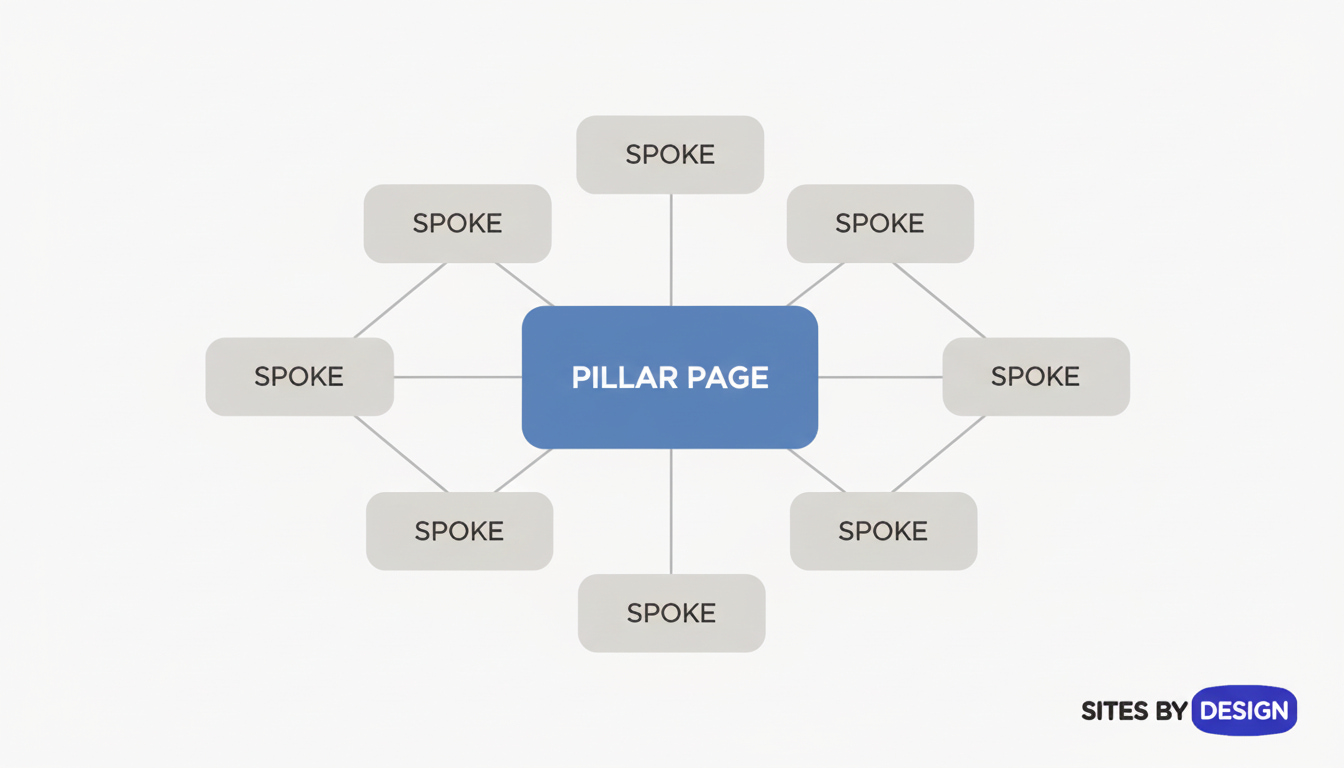
This structure creates a clear map of meaning. For people, it makes your site easier to explore and helps them move naturally from learning to comparing to taking action. For AI systems, it does something even more powerful: it signals that your business actually understands a subject more broadly than a single blog post could ever show.
Traditional SEO relied heavily on individual keywords. But in AI-driven search, the goal is no longer to win for one phrase. It’s to be understood as an authoritative source across an entire topic. A single page can’t do that. A topic cluster can.
When a pillar explains the whole subject, and the supporting pages answer the smaller questions people ask along the way, your website becomes the type of structured, interconnected content that AI engines can summarise, cite and trust. For a Sydney business competing in a crowded marketplace, that’s a major advantage. Here is a deep dive into what EEAT means for SEO in Sydney.
How a Pillar Page Differs from Its Supporting Spokes
A good pillar page is broad, not shallow. It sets context, defines terminology, explains common challenges and maps out what the reader should know before they make a decision. It doesn’t need to cover every detail. It just needs to set the frame for the entire subject and lay out the paths a reader can take next. This is the first step in building authority on a topic – with Google and your audience.
This is where the spoke pages come in. Each spoke explores one subtopic with genuine depth. If your pillar is about “AI SEO in Sydney”, your spokes might include pages on structured data, internal linking, entity optimisation, voice search or Sydney-specific ranking factors. On each spoke, the goal is to answer one major question cleanly and thoroughly.
What ties it together is the linking. The pillar links to every spoke in a way that helps readers find the next step without friction. Each spoke links back to the pillar, reinforcing the hierarchy and telling Google and AI systems, “this is the master source”. Spokes also link to each other whenever a connection helps the reader.
This architecture keeps your site organised. It also prevents overlapping content – a common issue on SME websites – because each page has one clear job.
Why Topic Clusters Outperform Ad-Hoc Blog Publishing
Many Sydney businesses publish blogs when they can, often jumping from trend to trend or topic to topic without a clear plan. This creates a content library that’s hard to navigate and impossible for search engines to interpret as a cohesive body of expertise. AI tools struggle even more, because they need clean relationships between pages to understand how one idea connects to another.
Topic clusters fix this by giving your content a structure that reflects how people actually learn. Visitors rarely go from a single blog post to a contact form. They need confidence first. They need clarity. They need to see that you’ve thought through the bigger picture.
Clusters create a natural learning path. Someone might start with a broad pillar (“How AI SEO Works”) and move through spokes that explain pricing, common mistakes, tools, examples and Sydney-specific nuances. This journey aligns with how trust develops – step by step, with each page reinforcing your credibility.
Clusters also help Google and AI assistants recognise your authority more easily. When your pages consistently answer related questions, use consistent terminology and link in a clean hierarchy, the signal is stronger. It tells search systems that your brand is not just part of the conversation – you’re leading it. That is a key part of doing quality blogging that actually ranks on Google and AI models.
Topic Clusters vs Keywords vs Entities: How They Fit Together
To understand why clusters matter in AI SEO, it helps to understand how search engines interpret meaning.
Keywords are still important, but they represent what someone types or says – not what search engines understand. A keyword might be “SEO Sydney” or “how to fix a blocked drain”.
Topics are broader themes. A topic like “AI SEO” might include concepts such as entity optimisation, structured data or voice search visibility.
Entities, however, are where modern search engines place most of their weight. An entity is a real thing – a business, a suburb, a service, a product or even an idea – that Google and AI systems recognise and store in their own knowledge graphs. When you reinforce those entities consistently across multiple pages, search engines build confidence in what your business actually represents.
Topic clusters sit in the middle of this progression. They help turn keywords into clearer topics and topics into strengthened entities by organising related content so every piece reinforces the others.
For example, a Sydney plumber might build a cluster around “Blocked Drains Sydney”. Over time, the pages within that cluster will naturally associate the business with the entity “blocked drains” and the location entity “Sydney”. AI systems, which rely on entity confidence, will read that repetition as expertise – not keyword stuffing.
Practical Examples for Sydney Businesses
A law firm in Parramatta might create a pillar on “Commercial Lease Advice in NSW”. Supporting spokes could include rent reviews, make-good rules, dispute resolution, fit-out guidelines and common traps for new tenants. When structured well, this cluster positions the firm as a subject-matter leader, not just another legal website.
A dental clinic might produce a pillar on “Teeth Whitening in Sydney” with spokes about treatment options, safety, sensitivity, results timing, pricing and GPs vs specialists. This creates a set of pages that serve both human readers and AI engines looking for safe, factual summaries.
A tradie working across the Sutherland Shire might build a cluster around “Blocked Drains in Sydney” with subtopics on stormwater drains, CCTV inspections, emergency callouts and prevention advice. The linking and structure help AI systems understand both the service entity and the location entity, increasing visibility in “near me” searches and voice results.
Entity-First Approach to Content Clusters
Before writing anything, map the entities you want search systems to associate with your business. These include your brand name, your main services, your local areas, your industry terminology and your proof points (such as certifications or case studies).
When this information appears consistently across your pillar, spokes, About page, footer and Google Business Profile, you reduce ambiguity. AI systems don’t need to guess who you are or what you specialise in. They can match your brand to the right entities immediately.
Spokes should always match real search intent. If a subtopic does not answer a genuine question your audience asks, it won’t contribute meaningfully to your topical authority and it won’t help AI systems retrieve your content as evidence.
How Structured Data (Schema) Strengthens a Topic Cluster
Search engines and AI assistants rely on structured data (schema) to validate what they’re reading. Schema markup labels your content in a machine-readable way, telling AI systems directly who you are, what you offer and how your pages relate.
For topic clusters, helpful schema types include:
- Organization and LocalBusiness to identify your business details and service areas
- Service to describe what you provide
- FAQPage for question-based sections that AI can lift into answers
- Article or BlogPosting to formally identify your content assets
- Review to support trust where genuine customer feedback is present
When schema supports your topic cluster, AI systems have a much easier time retrieving accurate facts about your business and including them in AI overviews, assistants and answer boxes.
Creating Internal Linking That Makes Sense to Humans and AI
Internal linking is the glue that holds a topic cluster together and a key part of how to build EEAT. Without it, a cluster is just a group of related pages. With it, your content becomes a structured knowledge map.
Every pillar should link to its spokes in a way that helps readers choose their next step. Those links should appear early, not buried in a conclusion. Spokes must link back to the pillar, reinforcing the relationship. And when two spokes naturally relate – for example, “pricing” and “common mistakes” – a link between them strengthens the cluster and improves navigation.
The anchor text matters. Clear phrases like “AI SEO for Sydney businesses” or “blocked drain costs in the Inner West” tell both humans and machines what to expect when they click. Weak anchors like “read more” waste an opportunity to strengthen your entity signals.
Finally, internal links prevent content cannibalisation. When every page has a distinct role in the cluster, you avoid creating multiple pages that accidentally compete for the same query. This keeps your architecture clean and your message consistent.
Where Topic Clusters Fit in The Future Of AI-Driven Search
Search isn’t becoming harder. It’s becoming more selective.
AI-driven systems are raising the bar for what gets surfaced, summarised and recommended. They favour clarity over noise, structure over scatter, and genuine understanding over surface-level relevance. Topic clusters fit naturally into this shift because they reflect how people actually learn and how AI now evaluates expertise.
For Sydney businesses, this matters more than ever. Competition is tight, attention is short, and the first answer someone hears is often the only one they act on. When your website clearly demonstrates that you understand a subject from every angle, you’re no longer just competing for rankings – you’re earning trust before a click even happens.
Topic clusters don’t replace good SEO. They strengthen it. They give your content a backbone, your expertise a clear shape, and your brand a stronger position in the way search engines and AI systems understand the world.
Once that foundation is in place, everything else works harder – from visibility and engagement to conversions and long-term growth.
Thinking About How This Applies to Your Business?
If you’re unsure whether your current content structure is helping or holding you back, a clear-eyed review can make a real difference. At Sites By Design, we help Sydney businesses build topic cluster strategies that align with real search behaviour, AI systems and commercial goals – not generic templates.
If you’d like to understand where your site stands today and what an AI-ready content structure could look like for your industry, book a consultation with our team and talk it through properly.
FAQs About Topic Clusters and AI SEO in Sydney
1. What is the purpose of a topic cluster in SEO?
A topic cluster organises your content so search engines can clearly recognise what you specialise in. By linking a main pillar page with focused supporting articles, you give Google and AI systems a structured map of your expertise. This makes it easier for them to crawl your site, understand your authority and show your content to people looking for that topic.
2. Are topic clusters still relevant?
Absolutely. Today’s rankings are won by showing genuine subject depth, not chasing isolated keywords. Topic clusters provide that depth in a clean, well-organised way. They help Google understand your site’s structure and make it easier for AI tools to cite your answers when summarising information.
3. What are the 4 pillars of SEO?
The four pillars of SEO are technical SEO, on-page SEO, content and off-page SEO. Together, they create a complete optimisation strategy. Technical SEO makes your site stable and fast, on-page ensures clarity, content proves your expertise and off-page brings authority signals through links and citations.
4. Why are topic clusters important?
Topic clusters help search engines understand how your content fits together. They show that you aren’t just writing about a subject once – you’re covering it deeply and from multiple angles. Over time, this structure builds topical authority, which improves your chances of ranking well and appearing in AI-driven summaries.
5. What is the difference between a keyword and a topic cluster?
A keyword is a single phrase someone searches for. A topic cluster is a group of related content pieces that explore an entire subject. Each spoke may target different keywords, but together they show search engines that your business understands the broader topic those keywords belong to.
6. What is the difference between keyword and entity?
A keyword is the text someone types into Google. An entity is a real-world concept, person, place or thing that Google understands through its Knowledge Graph. Keywords help search engines match phrases. Entities help them interpret meaning. Modern SEO focuses on both – matching intent and reinforcing the right concepts.
7. How to optimize for entity SEO?
Start by identifying the entities that matter to your topic – your service types, your business category, your locations and your industry terms. Use these naturally in headings, introductions and schema. Keep your business details consistent across your website and listings so search engines can confidently match your brand to the right concepts.
8. What is entity match in SEO?
Entity match describes how search engines link a word or phrase to a specific concept. When someone searches for “Sydney electrician”, Google tries to match those words to the entity representing that service and location. The clearer your content and citations are, the stronger that match becomes.
9. What is an entity in SEO?
An entity is anything Google recognises as a unique, identifiable concept. It could be a business, a product, a suburb, a service or even a rule or idea. Entity SEO focuses on aligning your content with these concepts so search engines can easily understand who you are and what you offer.
10. How to find SEO entities?
You can find relevant entities by using tools like Google’s Knowledge Graph API, Google’s NLP tool, Semrush, Ahrefs or InLinks. These platforms show which concepts search engines associate with your content. They’re useful for checking whether the right entities are being recognised – and which ones you may need to strengthen.
11. What is entity optimization in SEO?
Entity optimisation means shaping your digital presence around the concepts search engines use to understand meaning. Instead of relying on keyword repetition, you focus on clarity, consistency and relevance. The goal is for Google to confidently link your brand with the services, topics and locations you want to be known for.
12. How many pages should a topic cluster include to start seeing results?
Most clusters start performing well once you have a strong pillar and four to six meaningful spokes. The key is depth, not volume. A small, well-structured cluster can outperform a large, scattered blog because every page reinforces the same core topic.
13. How often should I refresh cluster content for AI visibility?
Aim to review and update your cluster every three to six months. Even small updates – such as adding fresh examples, updating stats or refining explanations – keep your content current. AI systems pay close attention to recency signals, so regular refreshes help maintain visibility.
14. Do internal links matter more than backlinks for topic clusters?
Backlinks are still powerful, but internal links are the backbone of a topic cluster. They determine how search engines understand your site’s structure and which pages carry the most weight. Strong internal linking can lift your entire cluster’s authority even before external backlinks catch up.
15. How do topic clusters help my brand appear in AI Overviews and voice answers?
AI-driven systems prefer content that is structured, clear and easy to summarise. Topic clusters deliver that clarity. When your pages answer key questions in well-organised sections and link together logically, AI tools can extract and reference your insights with confidence – increasing your chances of being included in voice answers or AI summaries.